Writers of the Catskills: In Conversation with James Lasdun (TMWYR Episode #63)
Writers of the Catskills: In Conversation with James Lasdun
A series of interviews with literary voices living and writing in The Overlook Region.
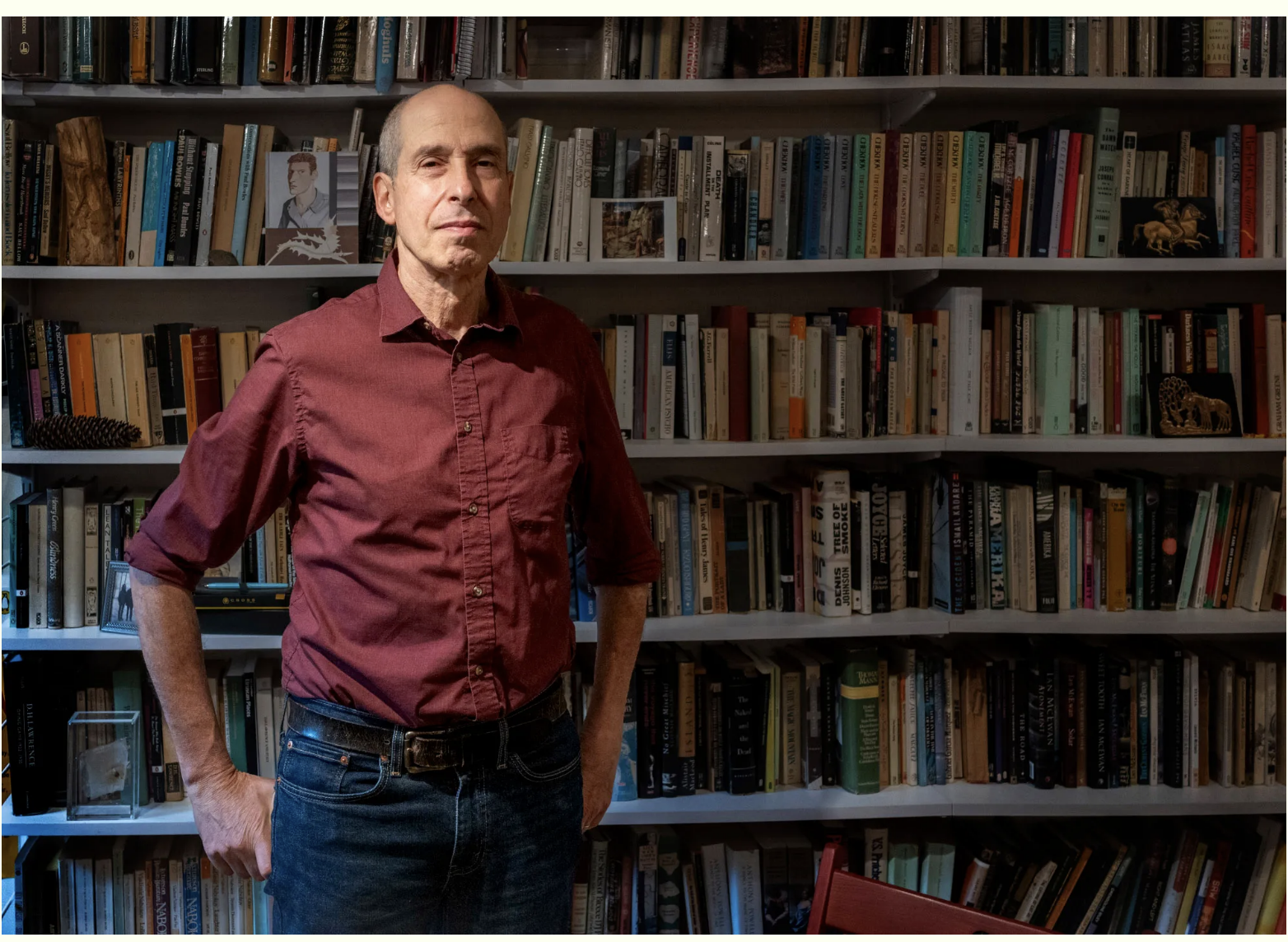
(Photo Credit: Dion Ogust)
My conversation on May 30, 2026, with James Lasdun
James, a resident of Woodstock since the early 1990s, has published both fiction and non-fiction, collections of poetry, books of short stories, essays, and a memoir, he’s written for film, is a writer for The New Yorker, and is the recipient of numerous awards for his work.
In our conversation, James discussed his approach to writing The Family Man, a non-fiction account of South Carolina lawyer Alex Murdaugh, and the murder of Murdaugh’s wife and son, “I wanted to get a kind of interiority, because to me that's what brings people to life, but I wanted to see if there's a way of getting to it that is at every juncture supported by something we know factually about Murdaugh. I wanted to get inside his head. I wanted to be able to feel what he was feeling in some way and articulate that in my descriptions of him.”
A condensed and edited version of my interview with James was published in The Overlook, community journalism serving Hunter, Hurley, Olive, Saugerties, Shandaken, Windham, and Woodstock, New York, and our conversation can soon be heard on my podcast, “Tell Me What You’re Reading”, available on Apple Podcasts, Spotify and wherever else you listen to podcasts.
Howard Altarescu
Of all the literary paths you’ve taken, is there one genre you prefer over the others?
JL: At different times one or another appeals to me. Lately I've become very interested in non-fiction, but I'm still writing fiction. And now, I found myself doing more reporting and journalism.
There's always been a dichotomy between sitting on your own at your desk for hours and hours and months and months, which is the only way you can really write fiction, and then there's the desire to be out in the world and to engage with the world and to learn about the world because if you don't do that you're actually going to end up drying up as a fiction writer. How to find the balance between those has been a challenge, and so I've taken the opportunities that have arisen to get out into the world when they do arise. Film, which is a collaborative process, that gets you out, and journalism is another, and at different times those have been the alternative to writing these very personal books, that require just sitting at my desk.
What inspired you to become a writer? What's your writing journey?
JL: I wasn't a voluminous reader in the sense I didn't devour books like some people do at school, but I read, and I was very affected by the books that I did read. I tended to read the same things over and over. I would read folk tales and fairy tales and myths when I was a kid. At school in England I had great English teachers, and literature affected me really deeply. If we would study a Shakespeare play, I was much more interested in that than anything else at school. Sometime in my teens, I thought, I want to understand how you produce that kind of excitement and I want to create it, that's what I want to do with myself.
I started out writing poems and short stories, which, looking back, in a way those are the most difficult things to do. But at the time they just seemed sort of manageable, because writing a novel seemed daunting, even though that was something I wanted to do.
Growing up in London, the really big ambition, the cool thing to do at that time, was to write for the stage. In 1970s London, it was a very active and kind of brilliant theatre scene and I had a sense in my mind that that would be the ultimate place to be to be working as a writer. And that's the one form I never have actually done. I've never written a play. I've never really even tried.
HA: Abby Thomas talked about starting with poetry because she didn't have to go across the whole page. And I don't remember if it was Dickens or who said, I would have written you a short letter, but I didn't have the time, so I wrote a long letter. Writing something brief is very difficult.
JL: It is, and I think it’s probably a good thing to start with. Even if you're going to write very long things, that's a big part of what writing is about, being able to distill and to move fast and be dynamic in a relatively short space.
What inspired you to write about the Murdaugh family murders, first for The New Yorker and then in your new book, The Family Man?
JL: The story kind of emerged at the end of Covid. I had a good COVID, as they say. It was lovely to be here with our kids back home and everything like that. I had been supposed to be traveling for a different non-fiction book, and that sort of came to an end, and I was kind of itchy. I wanted to get out into the world again. And then this story emerged, of this terrible double murder at a hunting estate in South Carolina. And at that time there was no indication that the father, Alex Murdaugh, was even a suspect.
I noted the story, but I didn't have the feeling that I've got to write about this because, to me, it was just another kind of bizarre, terrible tragedy. It wasn't until three months later when a very strange episode, sort of a next chapter, occurred. This Alex Murdaugh is on the side of the road and apparently changing a tire, and somebody reportedly drives by and takes a shot at him. And that seemed a bit weird. And I thought, well, okay, this is a vigilante story, because there does seem to be somebody out to get the family. But that story collapsed in about a day. And the next thing we heard was, actually, he had asked his cousin Eddie to kill him so his surviving son Buster could claim Alex’ life insurance. That story also fell apart later, but that took a while, and it hasn't completely fallen apart, but it probably isn't true.
It was that piece of it that caught my attention, because I had written a novel called Seven Lies, which has a plot development that's rather like that. It involves a guy who arranges to have someone kill him so that his wife can collect the life insurance. And I'd always felt a bit kind of iffy about that. I thought it was a bit of a stretch and I had a slightly guilty literary conscience, as we say, about that twist. But here it was, apparently happening in real life. And it seemed to validate my sense that this is something that could actually happen. So that really caught my attention. And I began thinking, okay, this might be worth following. Still, there wasn’t any public indication that Alex Murdaugh himself was going to turn out to be the killer of his own child and wife. But at that point I got interested enough to suggest it to my editor at The New Yorker.
HA: One of the things in your book that I found so impressive and even to this day and even in The New Yorker article a couple of days ago, your self-doubt, your uncertainty, your transparent uncertainty, as opposed to being directly accusatory and conclusive. And I think that's so valuable, that it adds to your credibility tremendously, I believe.
JL: Well thank you. I mean I you know I did I have enormous difficulty believing.
Murdaugh presented a real puzzle to me. And I was surprised, even before the indictments landed, people had begun to say, well he's, you know, he's going to get accused. He had been accused of stealing money from his law firm and their clients, but I was surprised at the ease which not everybody, but a lot of people, seemed to think, well, okay, because he stole money from vulnerable people, which he did, and he was absolutely merciless in that way. Because he did that, therefore it followed that he would kill his own child.
You can see that there are really awful things about Murdaugh, where he seems to operate on exploiting people's most intimate feelings of trust and kinship and all those things. But to me there was still a significant gap to be crossed between that and this apparently long gestated, very cold-blooded plan, luring his wife to where he would kill her and their son. Writing the book was an attempt to see if there was a way I could get myself across that gap. By the time I started writing the book, he had been found guilty of the murders, and the evidence was very compelling. I mean it's only circumstantial, but you know, there was good evidence. And there didn't seem to be any other suspects. It was necessary for me to form my own kind of psychological profile that would enable me to understand how this absolutely unimaginably terrible deed was done.
How did you approach the telling of the story of the murders?
JL: I approached the whole story with the sense that you have to be able to follow your character, like a character in a novel, to understand them as they go from A to B to C. You have to understand the internal processes. the psychological processes, the emotional processes that get them from whatever their starting point is to whatever the kind of crisis they’re facing.
I didn't know very much about Alex Murdaugh, but one thing that was clear was that he was not an absolutely obvious kind of nutcase. I mean he wasn't a maniac in that way. He was a very functional lawyer. He was living this very excessive sort of life, a large life, but it wasn't particularly abnormal. He was a family guy. And even by the accounts of his most hostile and bitterest enemies, people who had every reason to loathe him, he was a very loving father and, although there are some questions about this one, a fairly devoted husband.
There's also a very complicated psychology around the involvement of his son in a boat accident that killed a girl on board. And there are many pieces of it. But I think one piece of it might have been, if you really are going to kill your son under those circumstances, you might tell yourself, yes, my son is looking at jail time, it's going to totally wreck his life as a young man. Also, he's not going to get to keep our wonderful estate because we're going to lose it because of my embezzlement. And the kid is devoted to this estate. So, I think in Murdaugh’s mind he might have had that feeling of this is partly for his son's sake, because we know from other family annihilator stories that there is this kind of self delusion or sort of nonsense basically that these people tell themselves. And among those quite often is a sense that they're protecting their offspring from the shame of whatever it is that's going to befall them.
HA: You keep coming back in the book and here to the traumatic killing of a child. It appears to me that really affected you, as it did me.
JL: It's just very hard to imagine a father killing his child. It's very hard to believe, and there's this phrase that I heard for the first time during the trial, “family annihilator”, which turns out to be a sort of recognized criminological category. I didn't know anything about it, I’d seen stories in the press, occasionally you'd hear somebody who did it, but it never really caught my attention. But I began reading the literature. There is not, as far as I can tell, there's not a great deal of it, but there are these case studies. And they were very interesting to read, and they shed a lot of light on Alex Murdough. I mean, he fits into the category in some ways, but there are a couple of ways in which he really is an outlier.
One of the ways you try to understand some very extreme or very unusual form of behavior is you look for precedent. Because if the thing is totally unprecedented, it's very hard to believe it. Or put it this way, it's easier to accept something like this could have happened if it turns out that it's not the first time it has happened, that there is some kind of latent human propensity for doing this under certain circumstances. And I looked very closely at that and that's quite an important piece of the book.
You know, I'm not a professional criminologist or psychologist, but I do feel I understand, and the element of psychopathy or sociopathy was sort of applicable to Alex Murdough. Terms like sociopathy that one has kind of come across, terms like family annihilator that I hadn't come across, once you sort of look into them, they do shed some light. Even if it's only to show well he's not like that or he's not like this kind of family annihilator, but maybe he's like that kind. It was a dark place to spend time in.
When writing the book did In Cold Blood and Truman Capote have any influence on you?
JL: I've read the book a couple of times. It's brilliantly done and very enjoyable to read. But there's a very significant thing that I don't think is possible to do anymore. I certainly wouldn't want to do it, which is that it's this sort of a semi-novelized version, semi-fictionalized version of reality, in the sense that Capote abides by the facts that he knows, but he's absolutely sort of cavalier about attributing his own sense of what people were thinking at this moment or feeling at that moment.
And I wanted to get that kind of interiority because to me that's what brings people to life, but I wanted to see if there's a way of getting to it, that is at every juncture supported by something we know factually about Murdaugh. I did want to get inside his head. I did want to be able to feel what he was feeling in some way and articulate that in my descriptions of him. But I wanted the reader to be very conscious that everything I was saying was founded on a factual detail, like whether it's something we've heard him saying or so many things we've heard other people saying. Or the rare moments where I do conjecture, I make it very clear that I'm just conjecturing this, and also I make it clear what I'm basing the conjecture on.
That's not Capote's way of doing things. And the challenge for me was to do that in a way that wouldn't read clunkily because you can imagine how that could become like a sort of legal brief or something. You don't want it to read like that.
What has been your writing routine?
JL: When things are on the way, I get up in the morning and I write for as long as I can. It's sometimes a whole day. I don't have trouble with that. I didn't have that sort of concentration when I was much younger. But I’m now more single-minded, more focused generally. And it's not hard for me to sit down and get to work. I have the opposite problem now, which is I get kind of antsy if I'm not writing. I think it happens to a lot of writers as they get older and they feel like their time is limited, so I actually sometimes have to make a conscious effort to pull myself away and get outside, have a walk.
That is a big advantage of non-fiction, that there's always some reason to sort of either go somewhere or pick up a phone and talk to someone.
There’s a lot of time sitting at a desk and just kind of figuring it out. You have to do that. And also, you're answerable to the truth when you're writing non-fiction. So you've got to have all your sources around you and you've got to be constantly checking them.
What was your writing process when you wrote The Family Man?
JL: I had a sort of shape in my head. I didn't detail but I knew that I was going to build it partly out of the process of investigation itself, that I would document myself in kind of almost real time. It seemed like a way of making it alive, and also because my doubts were a piece of it for me, I thought well in a way that's kind of helpful on a dramatic level.
I would hope that the reader begins to share some of that internal questioning of is he guilty, is he not, is there some other way of looking at it? And to take them on that journey.
I knew I wanted to end by seeing if I could, on the basis of everything that I had turned up, if I could offer a plausible account of how those murders occurred and what was going on inside his head and what was going on physically. And so that was the sort of shape that I had in mind. And more or less that's what I did.
What has been your writing process when you write fiction?
JL: I'll get a sense of something as a whole. I've just known that it's going to start here, it's going to have this happen and then it's going to end there. But usually with short stories that's not the case. I usually just start out with a few images, a character, a situation, some kind of critical mass occurs and you start writing and you see where it takes you.
It's that feeling of the critical mass, I've got enough to get going and let's see where it goes. That's what makes it sort of exciting, although it can also make it a terrible waste of time because it sometimes goes nowhere.
What's the biggest challenge you’ve faced as a writer?
JL: I mean there are different challenges but for me, it's all a sort of internal thing. I never feel quite adequate to the task. I always feel a bit out of my depth. I always feel it should be better than it is, it should be livelier or something and so you know the challenge is always with wishing you were better than you are. But you have to work with what you have and then try to make the best of what you have.
Were there particular challenges in writing about the Murdaugh murders, coming in as an outsider in the low country in South Carolina?
JL: I moved to the U.S. at the age of 27, and found that being in the position of sort of an outsider is actually one that suits my temperament. It's almost as if it formalizes something I had sort of felt a little bit anyway growing up in England from a sort of Jewish family, assimilated but there was always this sense of being not quite of that world that we lived in. And so moving to the States in a way it was out there. You're an outsider, you're a Brit. And that has worked for me. And people have different expectations in terms of how they expect you to see things. They don't expect you to have the insider sort of deep history sense. But I think they value the structural freshness of your perceptions of places.
I thought that, you know, so I'm a Brit, I live in the Northeast, I've never spent any time in the South. There's no point pretending I'm somebody who understands the South or has some kind of deep knowledge of the South, but I was curious about the South. I'd always wanted to spend some time there. and I thought, well, you know, what I do have is I’m this outsider, and I think people responded to that. I mean they're very friendly down there anyway, very friendly, very cordial.
I got down there pretty soon after the roadside shootings, but the area had already been kind of overrun with journalists, and by then Netflix and HBO had gone through the whole area signing people up to exclusives. So there were some people who wouldn't talk to me, or they'd talk off the record, but a lot of people did talk. I didn't experience any sort of hostility, but it was very hard to get the prosecution and the police to talk. The local reporters were very, very helpful to me, they don't give you their sources, but they'd sort of tell you things, they'd guide you, they'd explain things that wouldn't make sense otherwise. So I have a huge debt of gratitude to them and they were very good. I thought the local coverage of this case was great because this was a very powerful family, a very well connected family, and there were local reporters sort of onto them, even before the murders, really from when his son caused the death of Mallory Beach in a boating accident, or possibly even before. So the reporters had kind of driven this story and also some of the local civil litigators. And they were helpful to me too, although you have to be careful with them because they always have a particular axe to grind and they're coming at it from a particular point of view.
As you developed as a writer, was there writing advice you received that has been valuable to you?
JL: I had a university professor, a very good poet, a guy called Charles Tomlinson, who I gave my poems to and he encouraged me to write. That was the most impactful. But he was tough too because I remember showing him some poems and he obviously didn't like them at all, and he gave me his reasons and I think when there's somebody you really respect, you really listen to what they have to say.
I also learned from the writers I admire, just by trying to understand what they do and how they do it. But, my real debt is to my English teachers who taught me to read in a very particular way, very closely. That was how it was done at the school I went to. You really began to look at any passage of literature as a series of choices by a writer. They're doing this here and why are they doing this and what effect does it have on what happens five pages later or whatever. You're really thinking your way into the writing process. And you're asking yourself, well, is this working? If so, why is it working?
If you're getting bored, what's gone wrong? You know, is it just that you're zoning out, or is there something that's kind of not working very well in the text? And so it's always been this very kind of practical act for me. and I read to do that. And it doesn't diminish the pleasure of reading. I find it enhances it. And, it’s a discipline that is very helpful to have had imposed on me as an impressionable kid.
You mentioned there are writers you admire, so who would those be?
JL: When I really started writing novels, it was the Russians; Chekhov, and I came sort of late and resistingly to Dostoevsky, and Tolstoy.
I've got more into non-fiction as well. I never used to read much nonfiction until I started writing it to be honest. I mean I read some but I wasn't a big non-fiction reader. I'm still not a huge non-fiction reader, but there are certain people who I like. I was reading a lot of Janet Malcolm as I was writing my book. In fact I think I might have read everything she's written, they're all about human folly in one form or another. She wrote about literature too. She's a very astute literary critic. She wrote a book called The Journalist and the Murderer, which I talk about a little bit in my book, and she has a very scrupulous, precise, probing style. You really feel someone thinking on the page.
Do you hear from readers?
JL: You never used to get much, you'd get the odd letter and usually if somebody's bothering to write to you it's because they like your book. You don't often get anti-fan mail. But with social media, Amazon reviews, Goodreads, all that stuff, suddenly if you want to hear what your readers are thinking, there's a place for them to express it and you can go look at it.
And I've learned it's probably not a good idea to do that, or shouldn't do too much of it because you can tell yourself, I'm not going to let it affect me but it kind of gets to you.
I'm not writing to please as many people as possible and be guided by what they say. I write to satisfy myself, and in the hope that if I do that I sort of satisfy some other people. It's all you can do. There are people who try to second guess the market and write for that. I guess some people do that very well, but it's not something for me.
Has living in Woodstock had an influence on your writing in any way?
JL: Huge. I've written about the area a lot. My novel The Fall Guy is totally set here, and Afternoon of a Faun is partly set here. My book of poems called Landscape with Chainsaw draws from the landscape, the poems draw from the place very much.
Alright, what have you done for us lately, what’s on deck?
JL: I've been working on a novel for a long time; coming soon, or when the time comes to move on from The Family Man.
What have you recently read? What's on your night table?
JL: I quite recently read Katie Kitamura’s book Audition, which I thought was a very interesting book. I read Ben Lerner's Transcription, which just came out and which I liked a lot. I think a lot of people will be talking about On the Calculation of Volume by Danish author Solvej Balle. I haven't started reading it yet. There's four short volumes that I was sent and I'm curious to see because I've heard it's good. I have Thoreau’s journals by my bed that I dip into from time to time. They’re wonderful.
I also got very into listening to classical piano music lately. I didn't know why exactly. It was just suddenly what I wanted to listen to almost exclusively. I was listening to the central classical period, so Bach, Haydn, Mozart, Beethoven, Schubert, and I was sort of wondering why am I responding to this, I don't really know anything about music. I mean I can read music, but anyway I was listening. I remembered that this wonderful British pianist Alfred Brendel who recorded a lot of the stuff I was listening to, that he had also written about music, so I started reading his essays.
They've just been such a revelation, his essays on all these composers, and he's writing about them from the point of view of a professional player. But he's writing for the general reader too, except for the parts where he kind of quotes very complicated looking scores, which don't mean a lot to me. But aside from that, it's very accessible, it's fantastic stuff. He wrote all these in the ‘70s or ‘80s, I think.
And I recently realized why I was listening to this music. I grew up in London mostly, my parents had a weekend house in Sussex, and there was a lot of music in our house. My father's mother had actually been a professional pianist. She was an accompanist. And my father was an architect but he actually played quite good blues on the piano. He had a good ear and he would play these odd things on a Honky Tonk sort of upright. And my mother played and my sister studied music. So there was a lot of piano music which I guess is, maybe now that I think about it, maybe why I'm suddenly listening to it. You'd think that would have been so obvious to me, but I think I'm only realising it now.
HA: Thank you so much. This was really terrific. I appreciate it.
JL: Thank you.
*******